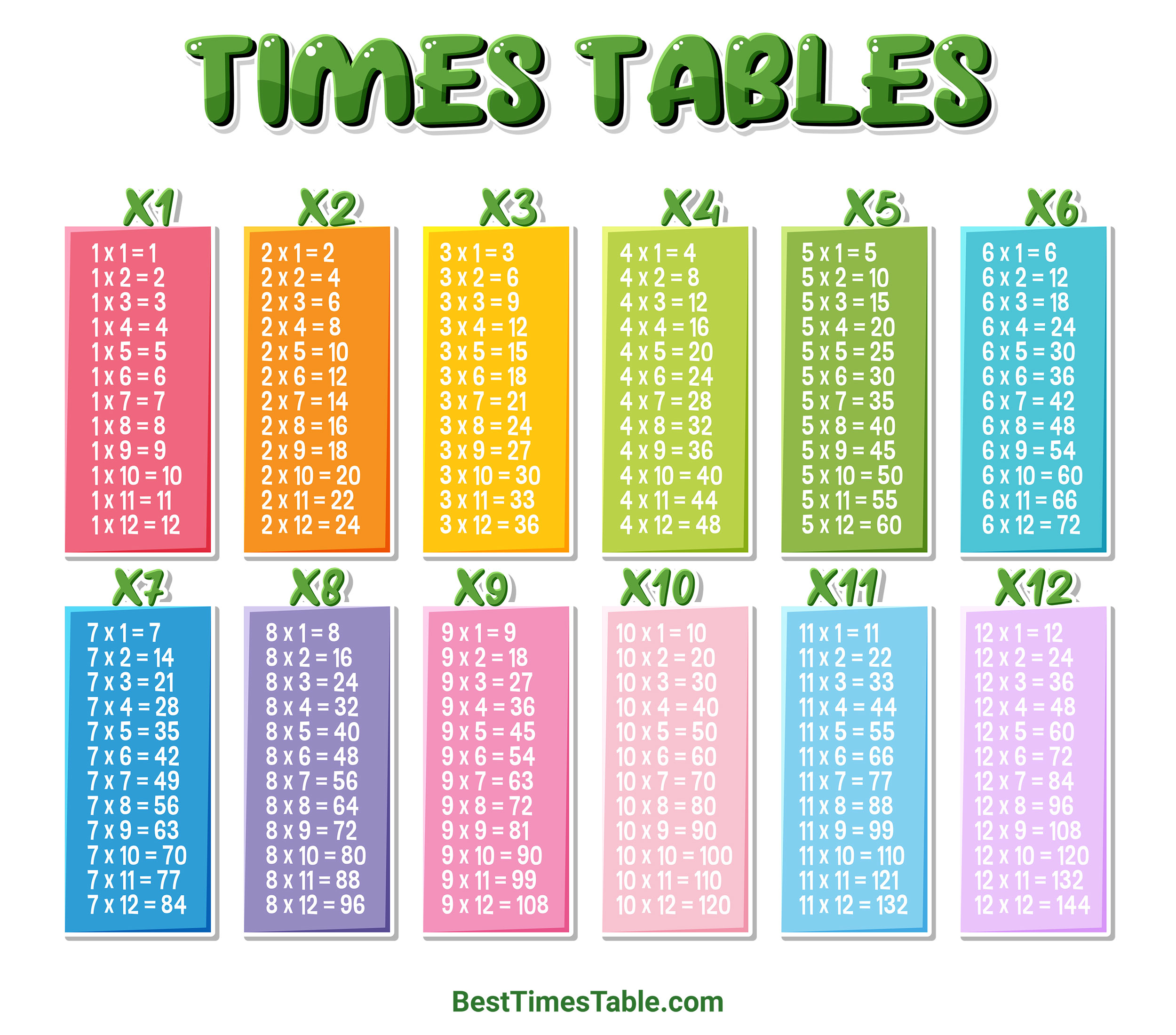
Learning times tables becomes much easier when you understand the patterns behind multiplication instead of trying to memorize every fact at once.
This guide explains a practical way to learn multiplication tables from 1 to 12, including the easiest tables to start with, useful mental-math shortcuts, ways to practice difficult facts, and how to move from calculation to fast recall.
The main idea
Understand the pattern first, then practice until you no longer need the shortcut.
For example: 8 × 7 = 56 can first be found by doubling 7 three times.
Where to begin
What Is the Best Order to Learn Times Tables?
You do not have to learn the multiplication tables strictly from 1 through 12. Some tables contain much easier patterns, and learning those first gives you useful building blocks for harder facts.
Step 1: Learn the 1, 2, 5 and 10 times tables
Step 2: Learn the 3 and 4 times tables
Step 3: Build the 6 times table from ×3
Step 4: Practice the 7 and 8 times tables
Step 5: Learn the 9, 11 and 12 times tables
Easy starting point
Start With the Tables That Have Clear Patterns
Some multiplication tables are easier to learn because their answers follow patterns that are easy to recognize.
Double
Ends in 0 or 5
Place value
For example, if you need to calculate 2 × 9, simply double 9 to get 18. For 5 × 7, you already know the answer must end in 0 or 5.
2 × 9 = 18
5 × 7 = 35
10 × 8 = 80
Build from known facts
Use Easier Times Tables to Learn Harder Ones
One of the most useful multiplication skills is learning how tables connect to each other.
Instead of treating every fact as something completely new, use a multiplication fact you already know as a starting point.
8 × 7 = 56
6 × 8 = 48
9 × 9 = 81
For example, if you know that 4 × 7 = 28, doubling 28 gives 8 × 7 = 56.
If you know 10 × 9 = 90, subtract one group of 9 to get 9 × 9 = 81.
Mental math
Useful Tricks for Each Times Table
Different tables have different patterns and shortcuts. Use these methods while learning, then gradually try to answer without them.
1 times table: keep the number
2 times table: double
3 times table: skip count by 3
4 times table: double twice
5 times table: look for 0 or 5
6 times table: double a 3 times table fact
7 times table: use nearby facts
8 times table: double three times
9 times table: multiply by 10 and subtract
10 times table: use place value
11 times table: use ×10 plus one more group
12 times table: combine ×10 and ×2
Visual learning
Use a Multiplication Chart to See the Patterns
A multiplication chart can help you see relationships between different times tables instead of learning them as separate lists.
For example, the chart is symmetrical because multiplication can be performed in either order.
6 × 8 = 48
8 × 6 = 48
The diagonal of a multiplication chart also contains square numbers such as 4 × 4 = 16, 7 × 7 = 49 and 12 × 12 = 144.
Use the chart as a reference while learning, then hide the answers and try to recall the products yourself.
Memory practice
Do Not Only Read the Times Tables
Reading multiplication facts repeatedly can make them feel familiar, but practice becomes more useful when you try to retrieve the answer yourself.
Look at the multiplication fact
Hide the answer
Check your answer
Mix the multiplication facts
Focused learning
Spend More Time on the Facts You Miss
You do not need to spend the same amount of practice time on every multiplication fact.
If you can already answer 5 × 5 instantly but repeatedly forget 7 × 8, it makes more sense to spend additional practice time on 7 × 8 = 56.
5 × 5 = 25
7 × 8 = 56
8 × 9 = 72
The individual lessons on this site include a Practice mistakes mode so facts you answer incorrectly can be repeated separately.
Practice routine
A Simple Times Tables Learning Routine
A clear routine can make multiplication practice easier to organize.
1. Choose one table
2. Learn the pattern
3. Answer without looking
4. Repeat difficult facts
5. Mix several tables
6. Test your speed
Start learning
Choose a Times Table
Each lesson explains the patterns and shortcuts for that specific multiplication table and includes interactive practice.
Try it now
Practice Mixed Times Tables
When you have learned several tables, use mixed questions to check whether you can recall individual multiplication facts without following a sequence.
Mixed tables
Times Tables Practice
Quick answers
Learning Times Tables Questions
What is the easiest way to learn times tables?
Start with tables that have clear patterns, such as 2, 5 and 10. Understand how each table works, then practice recalling the answers without looking at the sequence.
Which times tables should I learn first?
A useful starting order is 1, 2, 5 and 10, followed by 3 and 4. You can then use these facts to help learn 6, 7, 8, 9, 11 and 12.
How can I memorize the 7 times table?
Use facts you already know as anchors. For example, 7 × 5 = 35 can help you find 7 × 6 = 42, while 7 × 7 = 49 can help you find 7 × 8 = 56.
How can I remember 8 × 7?
8 × 7 = 56. One way to calculate it is repeated doubling: 7 → 14 → 28 → 56.
Should I learn times tables in order?
You can learn a table in order when first becoming familiar with its multiples, but eventually you should practice the facts in random order so you can recall each product independently.
Is it better to practice accuracy or speed?
Start with accuracy. Use strategies to find correct answers, then work on faster recall once you are consistently getting the multiplication facts right.
Can a multiplication chart help me learn times tables?
Yes. A multiplication chart can help you see sequences, symmetry, square numbers and relationships between tables. It is most useful as a learning aid before moving toward recall without the chart.
What multiplication facts should I practice most?
Spend the most time on facts that you answer incorrectly or that take much longer to recall. Once those become easier, mix them with multiplication facts you already know well.