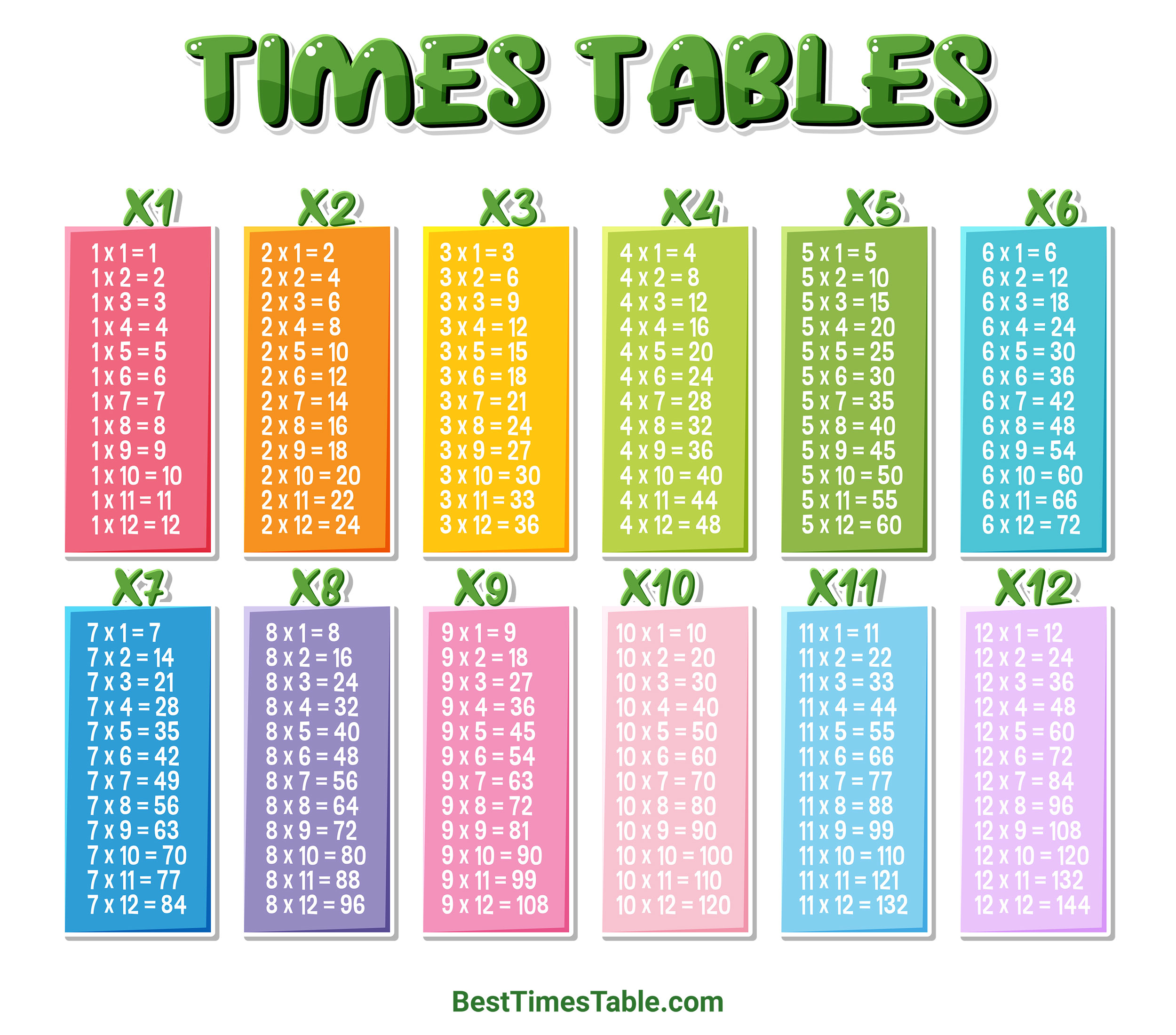
Multiplication facts are basic multiplication equations that are useful to recognize and recall quickly. For example, 6 × 4 = 24 and 8 × 7 = 56 are multiplication facts.
This guide covers the essential multiplication facts from 1 × 1 to 12 × 12, important multiplication rules, fact families and useful patterns that can help you understand how the facts are connected.
Multiplication fact
A multiplication fact combines two factors to produce a product.
7 × 8 = 56 → 7 and 8 are factors, and 56 is the product.
Start here
What Are Multiplication Facts?
A multiplication fact is a multiplication equation involving numbers and their product. Learning common facts makes it easier to solve calculations without repeatedly adding or counting.
= 12
= 42
= 72
Multiplication can also represent equal groups. For example, 4 × 3 = 12 can describe four groups containing three objects each.
Vocabulary
Factors and Products
Understanding a few multiplication terms makes multiplication facts easier to describe.
6 × 8 = 48
What is a factor?
What is a product?
What does the × symbol mean?
Essential reference
Multiplication Facts From 1 to 12
The standard 1-to-12 times tables contain the multiplication facts most commonly practiced when first learning multiplication.
You can also view these facts together on the multiplication chart.
Important rules
Multiplication Facts and Rules to Know
A small number of rules can help you understand many multiplication facts without treating every equation as completely separate.
Multiplying by 0
Multiplying by 1
Multiplying by 2
Multiplying by 5
Multiplying by 10
Useful shortcut
Turnaround Multiplication Facts
The order of the factors can be reversed without changing the product. This is called the commutative property of multiplication.
= 24
= 24
= 63
This means that knowing 7 × 8 = 56 also gives you 8 × 7 = 56.
a × b = b × a
You can see this symmetry clearly on a multiplication chart.
Connected facts
What Is a Multiplication Fact Family?
Multiplication and division are inverse operations. A set of equations using the same numbers can form a multiplication and division fact family.
6 × 7 = 42
7 × 6 = 42
42 ÷ 6 = 7
42 ÷ 7 = 6
Understanding these relationships can help you use a multiplication fact to solve a related division problem.
Patterns
Patterns in Multiplication Facts
Multiplication facts contain many predictable patterns. Recognizing them can make the facts easier to understand and check.
Even-number patterns
The 5 times table pattern
The 9 times table pattern
Square-number facts
See the dedicated square numbers guide for more examples and patterns.
Build new facts
Use Known Multiplication Facts to Find New Ones
If a multiplication fact is difficult to remember, you can often start with an easier fact and adjust it.
6 × 7 = 42
8 × 8 = 64
9 × 7 = 63
For example, if you know 5 × 7 = 35, add one more group of 7 to find 6 × 7 = 42.
For 9 × 7, start with 10 × 7 = 70 and subtract one group of 7:
70 − 7 = 63, so 9 × 7 = 63.
Check your knowledge
Multiplication Facts Practice
Try these questions before opening the answers.
What is 4 × 6?
What is 7 × 8?
What is 9 × 7?
What is 11 × 6?
What is 12 × 8?
Which fact is related to 6 × 9 = 54?
Recall practice
Practice Random Multiplication Facts
Once you understand the rules and patterns, practice facts in random order. This helps you recall each multiplication fact independently rather than relying on the sequence of a times table.
Mixed tables
Multiplication Facts Practice
Learning strategy
How to Remember Multiplication Facts
You do not need to approach every multiplication fact in the same way. Start with patterns and known facts, then gradually work toward direct recall.
1. Learn the easy patterns first
2. Use turnaround facts
3. Connect difficult facts to known facts
4. Practice retrieval
5. Repeat the facts you miss
For a more detailed learning strategy, see how to learn times tables.
Quick answers
Multiplication Facts Questions
What is a multiplication fact?
A multiplication fact is a basic multiplication equation showing two factors and their product, such as 7 × 6 = 42.
What are the multiplication facts from 1 to 12?
They are the products formed by multiplying the whole numbers from 1 through 12. Examples include 3 × 5 = 15, 7 × 8 = 56 and 12 × 12 = 144.
What are factors in multiplication?
Factors are the numbers being multiplied. In 7 × 8 = 56, the factors are 7 and 8.
What is a product in multiplication?
The product is the result of multiplying the factors. In 7 × 8 = 56, the product is 56.
Why is 7 × 8 the same as 8 × 7?
Multiplication is commutative, which means changing the order of the factors does not change the product. Therefore, both 7 × 8 and 8 × 7 equal 56.
What happens when a number is multiplied by zero?
The product is zero. For example, 12 × 0 = 0.
What is a multiplication fact family?
A multiplication and division fact family contains related equations using the same numbers. For example, 6 × 7 = 42, 7 × 6 = 42, 42 ÷ 6 = 7 and 42 ÷ 7 = 6.
What is 8 × 8?
8 × 8 = 64. It is also a square-number fact because both factors are 8.