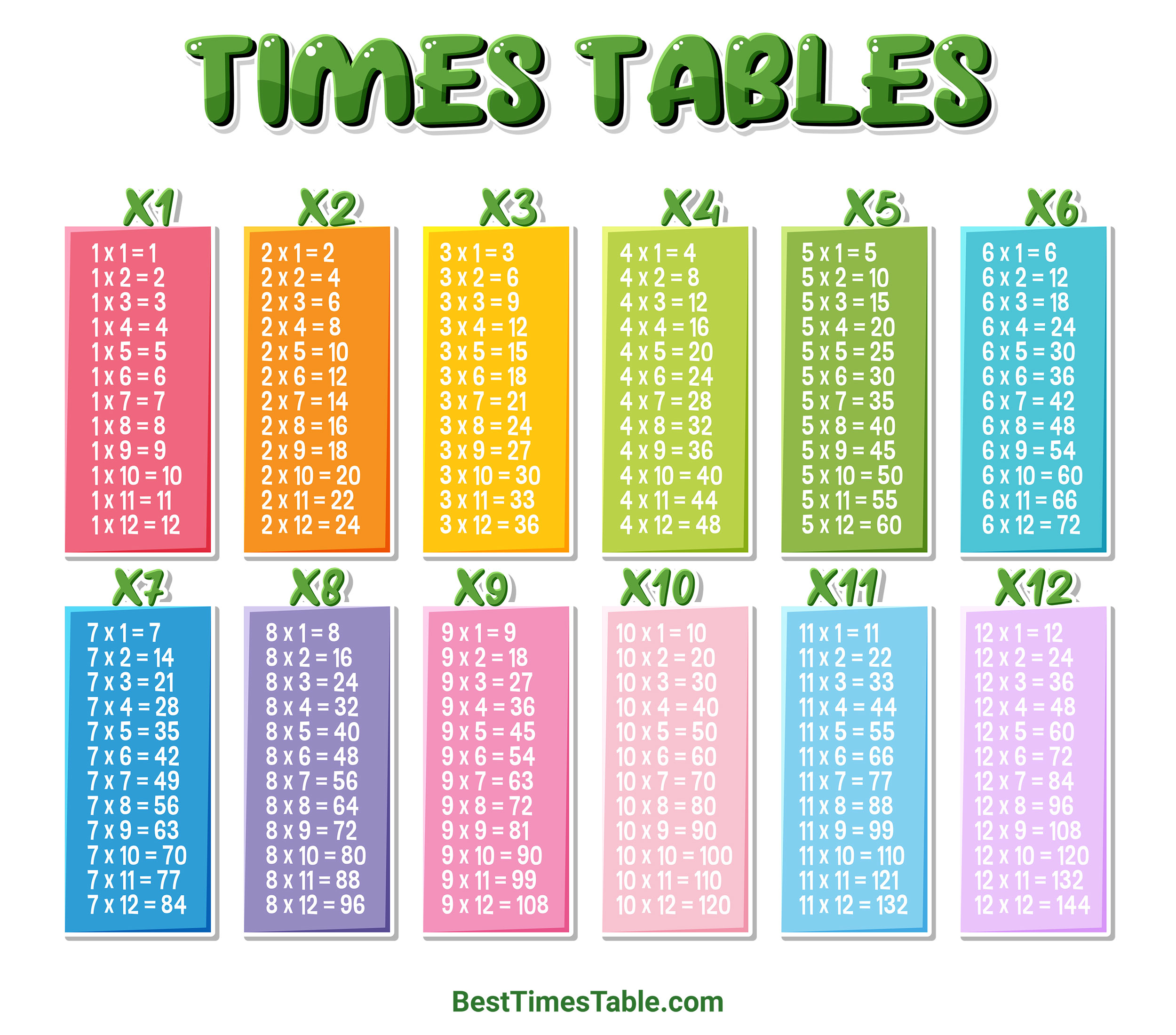
Make multiplication practice more engaging with simple times tables games. These activities are designed to help you recognize multiplication facts, match questions with answers, improve recall and build confidence through short challenges.
Use the ideas below to practice the 1 to 12 times tables in a different way from a traditional worksheet, quiz or timed test.
Game goal
Turn multiplication facts into short challenges that are easy to repeat.
For example: match 7 × 8 with 56 before moving to the next card.
Quick game
Play a Random Times Tables Challenge
Start with a quick mixed multiplication game using facts from the 1 to 12 times tables. Try to choose the correct answer without counting through the whole table.
Mixed tables
Times Tables Challenge
Game idea 1
Match the Multiplication Fact to the Answer
Create two sets of cards: one set with multiplication questions and another set with products. Shuffle them and try to match each question with its correct answer.
42
64
54
You can play alone by timing yourself, or with another player by taking turns to find matching pairs.
Variation: use only one table at first, then mix several tables together when the game becomes too easy.
Game idea 2
Multiplication Memory Game
Place multiplication question cards and answer cards face down. Turn over two cards at a time and keep the pair if the multiplication fact matches the product.
Start with 6 to 8 pairs
Mix questions and answers
Add more cards gradually
Game idea 3
Beat Your Previous Score
Choose one times table and see how many multiplication facts you can answer correctly. Record the result, practice the facts you missed, and then try again.
7 correct
9 correct
10 correct
The aim is to improve your own result rather than compare your score with another learner.
Game idea 4
Find the Missing Number
Instead of always asking for the product, hide one of the factors and work backwards.
7
8
8
This helps connect multiplication with division and makes the activity different from ordinary multiplication questions.
Game idea 5
Multiplication Bingo
Create a bingo grid containing multiplication products such as 24, 35, 42, 48 and 56. A caller reads multiplication questions, and players mark the matching product if it appears on their grid.
Caller says: 7 × 8
Player looks for: 56
You can limit the game to one or two tables for beginners or mix all 1-to-12 facts for a more difficult version.
Game idea 6
Times Table Race
Choose a multiplication table and move through its facts one at a time. Each correct answer moves you one step forward.
Choose a table
Ask questions in random order
Move one step for each correct answer
Choose your level
Games for Different Times Tables
Some multiplication tables are easier to use for beginner games because they contain simple patterns.
Beginner: 2, 5 and 10 times tables
Intermediate: 3, 4 and 6 times tables
Challenge: 7, 8, 9 and 12 times tables
Pick a table
Play With One Times Table
Select a table below to practice its multiplication facts before using them in a game.
Extra challenge
Extended Times Table Games
Once the standard multiplication facts are easy, use larger tables in the same games.
Mixed tables
Extended Multiplication Challenge
Keep it useful
How to Make Times Tables Games Effective
A game should still require the learner to retrieve multiplication facts rather than rely on luck.
Keep each round short
Use facts that need practice
Mix the order
Check every answer
Quick answers
Times Tables Games Questions
What are times tables games?
Times tables games are activities that use multiplication facts as part of a challenge, such as matching cards, memory games, bingo, missing-number puzzles or score-based activities.
Can games help with multiplication practice?
Yes. Games can provide repeated practice in a more varied format, especially when the activity requires learners to recall multiplication facts rather than guess.
What is a good times table game for beginners?
A simple matching game using multiplication questions and answers from the 2, 5 or 10 times tables is a good starting point.
What is a good multiplication game for two players?
Multiplication bingo, matching pairs and a times table race can all be adapted for two players.
Should times tables games be timed?
Not always. Beginners can focus on correct answers first. Timing can be added later when the multiplication facts are already familiar.
Which multiplication facts should I use in a game?
Use facts that match the learner’s current level, with extra repetition for multiplication facts that are often missed or take longer to answer.