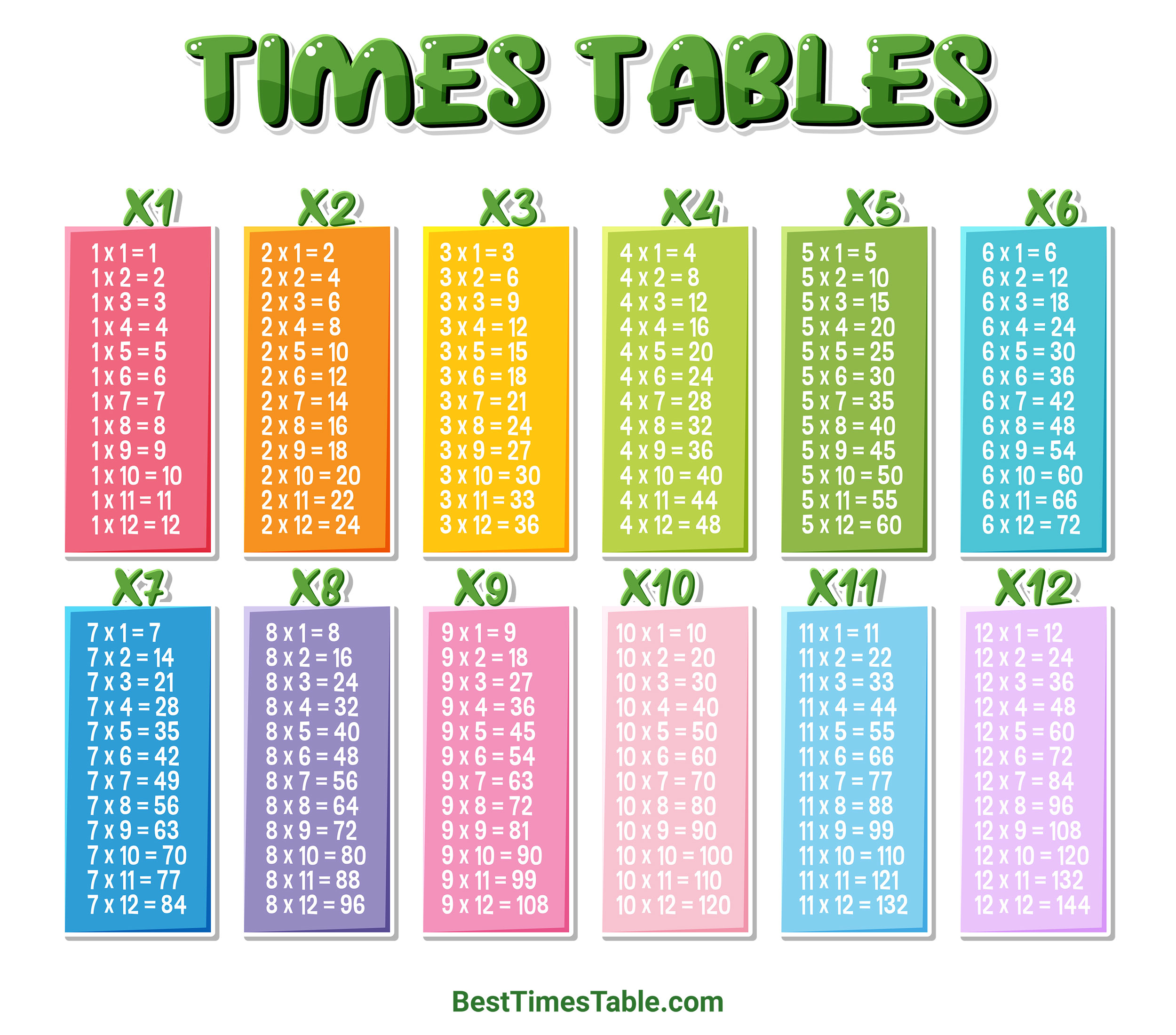
Practice your times tables from 1 to 12 with focused multiplication exercises. Choose one table to work on specific facts, or practice several tables together when you are ready for a bigger challenge.
This page is designed for regular practice rather than a formal test. Take your time, use multiplication strategies when needed, and repeat difficult facts until they become easier to recall.
Practice tip
Accuracy comes before speed.
If you forget an answer, work it out using a pattern or nearby fact before trying again.
Choose your focus
Practice One Times Table
Select a table below if you want to concentrate on one multiplication pattern at a time. Each lesson includes Learn, Practice, Practice Mistakes and Speed Test modes.
Mixed practice
Practice Times Tables 1 to 12
Once you are comfortable with several tables, use mixed multiplication practice. Questions appear in random order so you cannot rely on the sequence of one table.
Mixed tables
Mixed Times Tables Practice
Practice by difficulty
Choose a Smaller Group of Times Tables
You do not always need to practice all twelve tables at once. Working with smaller groups can make it easier to focus on the facts you are currently learning.
Practice Easy Pattern Tables
Start with multiplication tables that have simple and recognizable patterns.
Mixed tables
Practice 2, 5 and 10 Times Tables
Practice 3, 4 and 6 Times Tables
These tables have useful relationships. Multiplication by 4 can be solved by doubling twice, while the 6 times table can be connected to multiplication by 3.
Mixed tables
Practice 3, 4 and 6 Times Tables
Practice Harder Multiplication Facts
If you already know the easier tables, spend more time on facts from the 7, 8, 9 and 12 times tables.
Mixed tables
Harder Times Tables Practice
Use strategies
Ways to Work Out a Multiplication Fact
When an answer does not come to mind immediately, use a strategy instead of guessing. As you practice, try to move from working out the answer to recalling it directly.
Double for the 2 times table
Double twice for the 4 times table
Use the 5 and 10 patterns
Use a nearby multiplication fact
Use ×10 minus one group for ×9
Split ×12 into ×10 and ×2
Practice effectively
How Long Should You Practice Times Tables?
You do not need very long practice sessions to work on multiplication facts. Short sessions can be easier to repeat regularly and help you concentrate on the facts that need attention.
Choose a table
Practice difficult facts
Mix the tables
A useful routine is to begin with one table, identify the facts that take the longest to answer, and then finish with mixed questions to see whether you can recall those facts outside their usual sequence.
Example: if 8 × 7 and 8 × 9 keep slowing you down, practice those facts separately before returning to mixed multiplication questions.
Visual reference
Use a Multiplication Chart While Learning
A multiplication chart can help when you are still learning where individual multiplication facts fit within the tables.
Follow one number across a row to see all of its multiples, or compare matching facts on opposite sides of the chart.
6 × 8 = 48
and
8 × 6 = 48
Once a multiplication fact becomes familiar, try answering it without looking at the chart.
Extra practice
Practice Extended Times Tables
Ready to go beyond the standard 1-to-12 multiplication facts? Practice the 20, 30, 40 and 50 times tables using the same mental-math strategies.
Mixed tables
Extended Times Tables Practice
Quick answers
Times Tables Practice Questions
What is the best way to practice times tables?
Start with one table, use its number patterns to understand the facts, and repeat the multiplication facts that take the longest to answer. Once you feel more confident, mix several tables together.
Should I practice every times table at once?
Not necessarily. Smaller groups can be easier while learning. You can practice one table or a few related tables before moving to mixed questions from 1 through 12.
Which times tables should I practice first?
The 1, 2, 5 and 10 times tables are common starting points because they contain simple patterns. You can then build toward tables such as 3, 4, 6, 7, 8, 9, 11 and 12.
How can I practice difficult multiplication facts?
Use a nearby fact or multiplication strategy to find the answer, then repeat the difficult fact several times. Individual times table pages also include a Practice Mistakes mode for facts answered incorrectly.
Is mixed times table practice useful?
Yes. Mixed questions help you practice recalling individual multiplication facts without relying on the order of one times table.
Should I focus on speed or accuracy?
Accuracy should come first while learning. Once you can answer multiplication facts correctly, timed practice can help you work on faster recall.
What is 7 × 8?
7 × 8 = 56.
What is 8 × 12?
8 × 12 = 96.