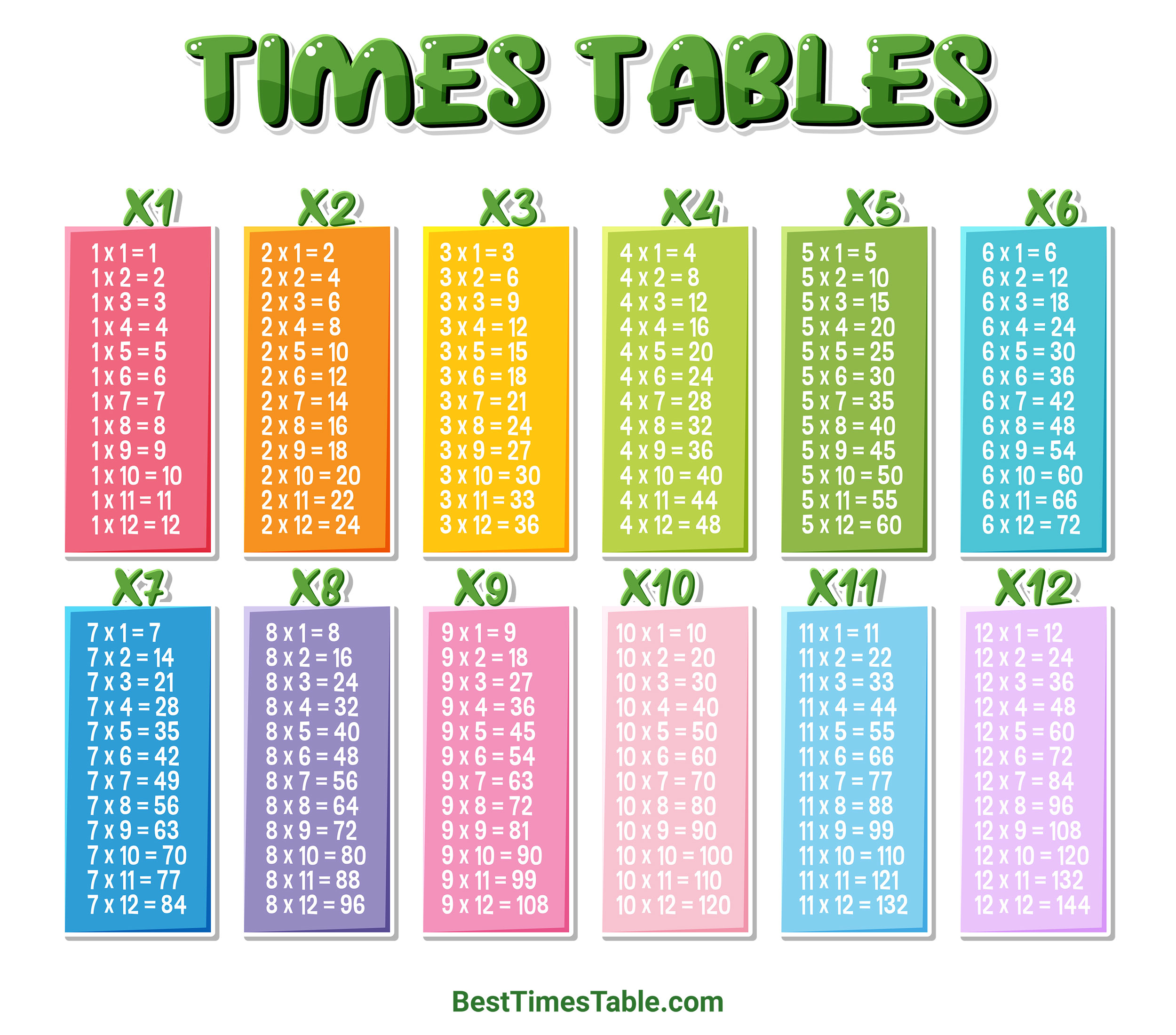
A square number is the result of multiplying a whole number by itself. For example, 5 × 5 = 25, so 25 is a square number.
Use this guide to learn the most common square numbers, understand how they appear in multiplication tables, and recognize patterns that make them easier to remember.
Definition
A square number is a number multiplied by itself.
For example: 7² = 7 × 7 = 49
Core facts
Square Numbers From 1 to 12
The first twelve square numbers are especially useful because they appear on the main diagonal of a standard 12×12 multiplication chart.
= 1
= 4
= 9
1, 4, 9, 16, 25, 36, 49, 64, 81, 100, 121, 144
These correspond to 1² through 12².
Reference list
Square Numbers Chart
1² to 5²
6² to 10²
11² to 15²
16² to 20²
Visual pattern
Where Do Square Numbers Appear in a Multiplication Chart?
Square numbers appear along the main diagonal of a multiplication chart because the row number and column number are the same.
4 × 4 = 16
7 × 7 = 49
10 × 10 = 100
12 × 12 = 144
You can explore this visually on the interactive multiplication chart.
Understand the pattern
How Square Numbers Grow
Square numbers do not increase by the same amount each time. The difference between consecutive square numbers grows by 2.
+3
+5
+7
The increases continue as odd numbers:
+3, +5, +7, +9, +11, +13…
This gives another way to understand the structure of square numbers.
Memory
Square Numbers Worth Memorizing
The square numbers from 1² to 12² are especially useful because they appear frequently in multiplication practice.
= 36
= 49
= 64
9² = 81
10² = 100
11² = 121
12² = 144
Practice
Square Numbers Practice Questions
What is 4²?
What is 7²?
What is 9²?
What is 12²?
What is 15²?
What is 20²?
Useful distinction
Square Number vs Square Root
A square number is created by multiplying a number by itself. A square root asks which number was multiplied by itself to produce a given square number.
= 64
= 8
= 144
For example, 64 is a square number because 8 × 8 = 64, and the principal square root of 64 is 8.
Times tables connection
Practice the Tables Behind Square Numbers
Square numbers are multiplication facts where both factors are the same. Practicing individual times tables helps make these facts easier to recall.
Quick answers
Square Numbers Questions
What is a square number?
A square number is the result of multiplying a whole number by itself. For example, 6 × 6 = 36, so 36 is a square number.
What are the first 10 square numbers?
The first 10 positive square numbers are 1, 4, 9, 16, 25, 36, 49, 64, 81 and 100.
Is 49 a square number?
Yes. 49 = 7 × 7 = 7².
Is 50 a square number?
No. There is no whole number that multiplied by itself equals 50.
What is 12 squared?
12² = 144.
What is 20 squared?
20² = 400.
Why are square numbers on the diagonal of a multiplication chart?
The diagonal contains cells where the row and column values are equal, such as 5 × 5 or 9 × 9. Those products are square numbers.