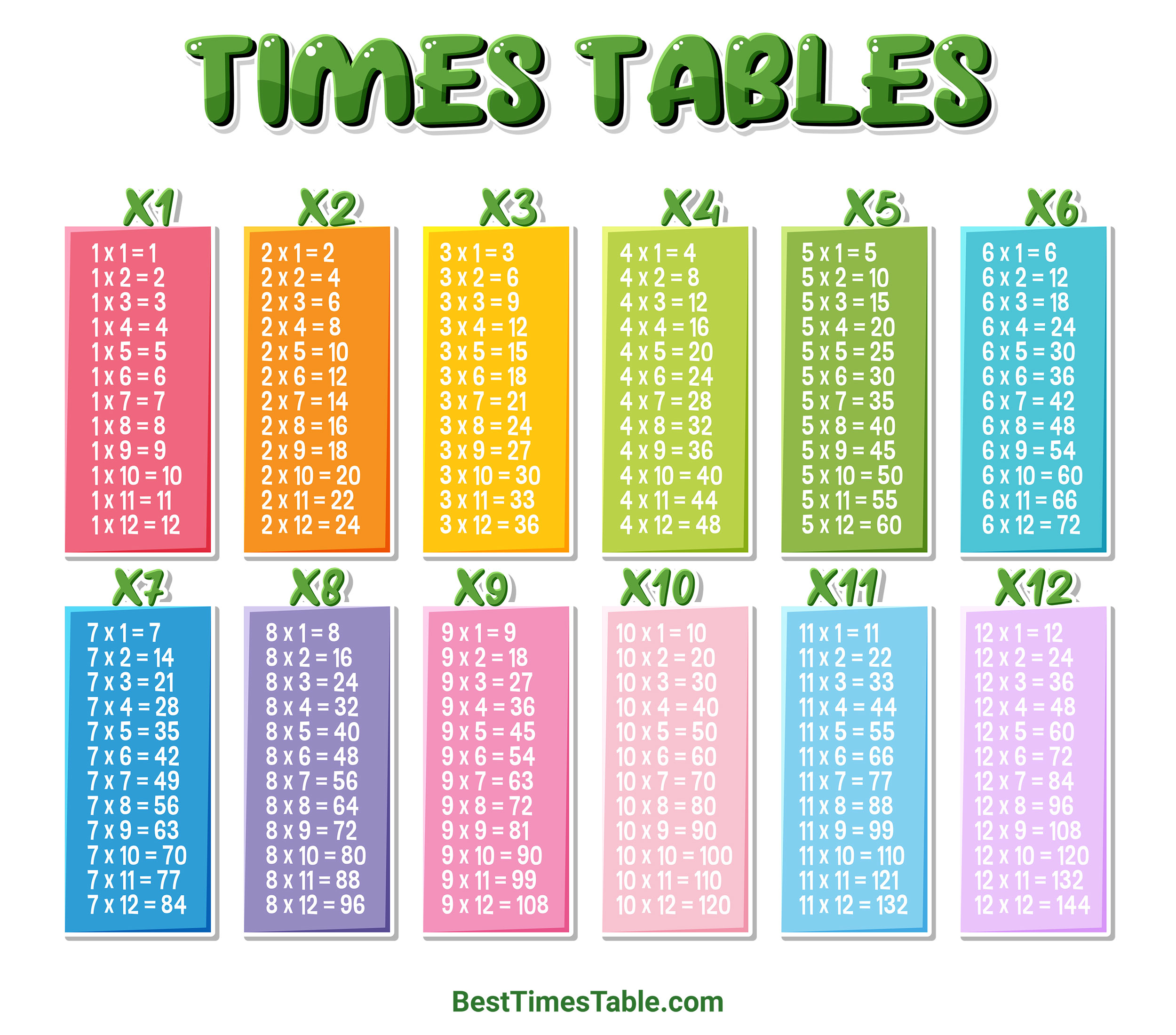
Take a times tables test to check how quickly and accurately you can answer multiplication facts. This page is designed as an assessment rather than a learning lesson: answer as many questions as you can, review your result, and use your score to decide what to practice next.
The test focuses on multiplication facts from the 1 to 12 times tables and is best used after you have already practiced the tables individually.
Test mode
Answer quickly, but do not sacrifice accuracy.
A strong result means you can recall multiplication facts without needing to work through the whole table.
Timed assessment
Take a Times Tables Speed Test
Choose an individual times table below to open its timed test mode. Each lesson includes a dedicated speed test that measures how many correct answers you can give before the timer ends.
How to use your result
What Does a Times Tables Test Measure?
A multiplication test can show whether you are able to retrieve individual facts quickly rather than simply calculate them with skip counting or repeated addition.
Correct answers
Fast recall
Repeatable results
A strong test result is not only about answering many questions. It also means making few mistakes and being able to repeat the result across several attempts.
Useful rule: if you are answering quickly but making many mistakes, return to practice mode before focusing on speed.
Before you start
When Should You Take a Times Tables Test?
A timed test is most useful after you already understand the multiplication facts you are being tested on.
Take a test after focused practice
Do not use the timer while still learning a new table
Retest tables that need more work
Compare your own results over time
Know the difference
Times Tables Test vs Quiz vs Practice
These activities have different purposes, so use the one that matches what you are trying to improve.
Practice: learn and improve difficult facts
Quiz: answer mixed multiplication questions
Test: measure speed and accuracy
Prepare efficiently
How to Improve Your Times Tables Test Score
The best way to improve a test result is usually not to take the same test repeatedly. Instead, identify the multiplication facts that slow you down and practice those facts separately.
1. Identify slow answers
2. Practice those facts without a timer
3. Repeat the fact in random order
4. Retake the speed test
Common challenge facts
Multiplication Facts Worth Testing
Some facts are useful benchmarks because they often require stronger recall than the easier pattern-based tables.
= 56
= 72
= 144
If you can answer these and similar facts immediately, your multiplication recall is becoming stronger.
Extended challenge
Test Larger Times Tables
You can also test your recall with the extended 20, 30, 40 and 50 times tables. These facts are especially useful for mental arithmetic with larger numbers.
Examples:
20 × 8 = 160
30 × 7 = 210
40 × 9 = 360
50 × 12 = 600
Quick answers
Times Tables Test Questions
What is a times tables test?
A times tables test checks how accurately and quickly you can answer multiplication facts. It is most useful after you have already learned and practiced the tables.
Is a times tables test the same as a quiz?
Not exactly. A quiz is useful for mixed questions and feedback, while a test is intended to measure performance, especially speed and accuracy under timed conditions.
Should a multiplication test be timed?
Timing can be useful when the goal is to measure recall speed, but learners should first be able to answer the multiplication facts accurately without time pressure.
What should I do if my test score is low?
Return to untimed practice, identify the multiplication facts that caused mistakes or delays, and work on those facts before taking another test.
Should I compare my score with other people?
Your previous scores are a more useful comparison. The goal is to improve your own accuracy and recall over time.
What is 7 × 8?
7 × 8 = 56.
What is 8 × 9?
8 × 9 = 72.
What is 12 × 12?
12 × 12 = 144.