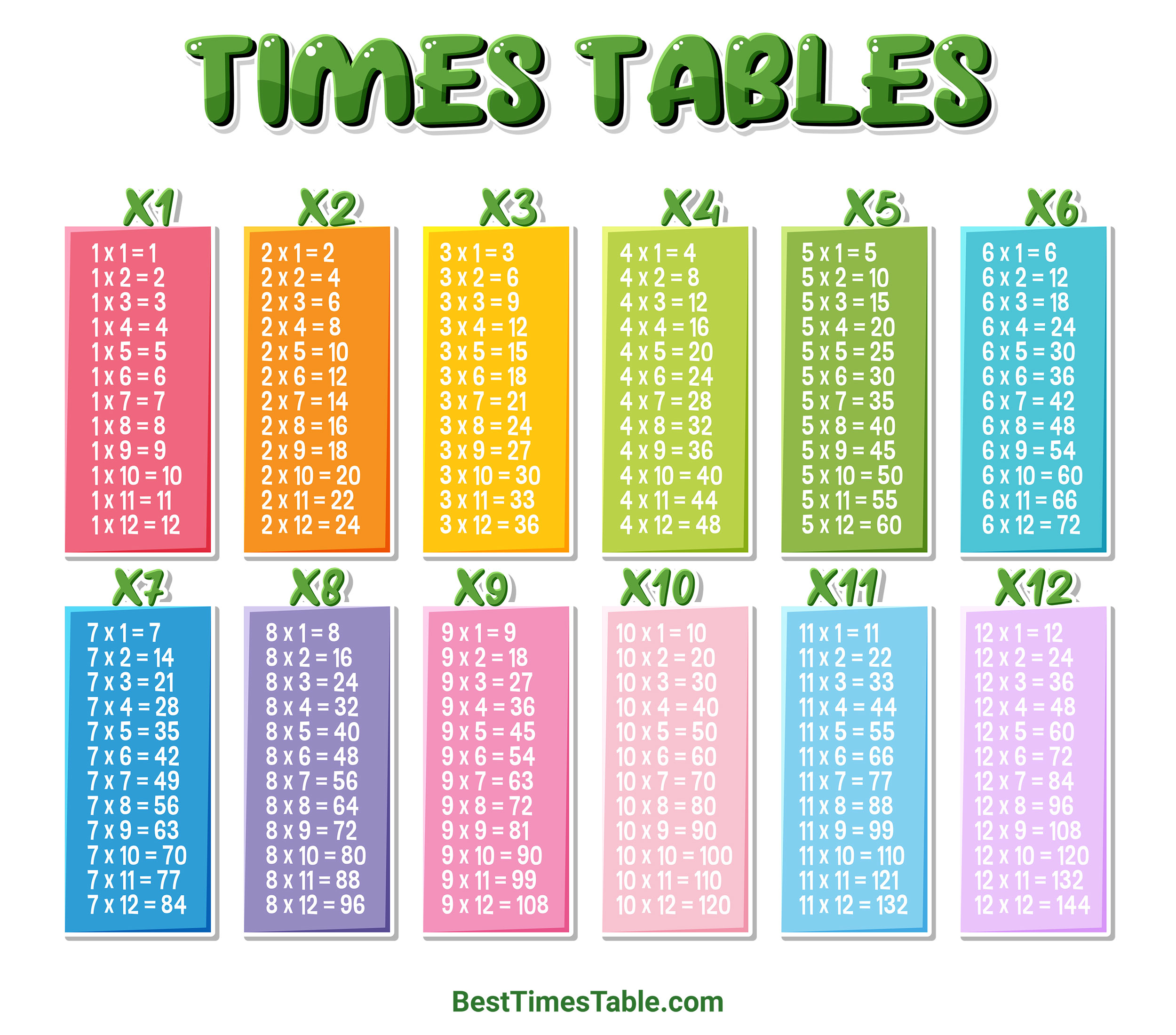
Test your multiplication skills with our free times tables quiz. Answer mixed questions from the 1 to 12 times tables, check your score instantly, and keep practicing until you can recall the answers without counting.
The questions are mixed randomly, so you will need to recognize each multiplication fact rather than simply follow a times table in order.
How the quiz works
Choose the correct answer, check your score, then move to a new random multiplication question.
Questions include facts such as 6 × 7, 8 × 9 and 12 × 4.
Mixed tables
Times Tables Quiz
Mixed multiplication
Times Tables Quiz From 1 to 12
This quiz mixes multiplication facts from all the standard times tables. Instead of receiving an entire set of questions from one table, you may see a 3 times table question followed by a 9 times table question and then a 7 times table question.
This type of mixed practice is useful once you have started learning several tables because the question itself no longer tells you which sequence of answers to think about.
= 28
= 48
= 108
Tip: try to answer each question before looking closely at all the choices. The goal is to recall the multiplication fact, not guess between the available answers.
Build recall
Why Practice Times Tables in Random Order?
Learning a multiplication table in sequence is useful at first. For example, you might learn the 6 times table as 6, 12, 18, 24, 30 and 36.
But knowing the sequence is not the same as being able to answer 6 × 8 immediately when it appears on its own.
A mixed quiz removes the predictable order and asks you to retrieve individual multiplication facts directly.
Instead of:
6, 12, 18, 24, 30, 36…
you may be asked:
6 × 8 = ?
As your recall improves, you should need less skip counting or repeated addition to find each answer.
Useful strategies
What Should You Do If You Don’t Know an Answer?
If a multiplication fact does not come to mind immediately, use a strategy instead of guessing. Different tables have different shortcuts.
For ×2, double the number
For ×4, double twice
For ×5, look for 0 or 5
For ×8, use repeated doubling
For ×9, use ×10 minus one group
For ×12, combine ×10 and ×2
Improve your score
How to Get Better at the Times Tables Quiz
Do not worry about answering every question quickly when you first begin. Accuracy is more important than speed while you are still learning the multiplication facts.
1. Work out the answer before choosing
2. Notice which facts slow you down
3. Practice the difficult table separately
4. Return to mixed questions
5. Repeat the quiz regularly
Focus your practice
Practice One Times Table
If certain questions in the mixed quiz are difficult, select that table below for a complete lesson with Learn, Practice, Practice Mistakes and Speed Test modes.
Extra challenge
Extended Times Tables Quiz
Once the standard 1-to-12 multiplication facts feel comfortable, try questions from the extended 20, 30, 40 and 50 times tables.
These larger multiplication facts can often be calculated using a smaller table and place value.
= 140
= 240
= 450
Mixed tables
Extended Times Tables Quiz
Another way to practice
Use the Multiplication Chart When You Need Help
If you repeatedly forget a multiplication fact, use the multiplication chart to see how it fits into the other tables.
For example, finding 7 × 8 on the chart also shows that 8 × 7 has the same product.
7 × 8 = 56
8 × 7 = 56
The interactive chart can also hide its answers, allowing you to use the entire grid as another multiplication practice activity.
Quick answers
Times Tables Quiz Questions
What is a times tables quiz?
A times tables quiz tests individual multiplication facts. A mixed quiz can include questions from several multiplication tables rather than presenting one table in sequence.
Which multiplication tables are included in this quiz?
The main quiz includes multiplication facts from the 1 through 12 times tables. A separate extended quiz on this page includes the 20, 30, 40 and 50 times tables.
What is the hardest times table question?
There is no single hardest multiplication fact for everyone. However, facts in the 7 and 8 times tables often require more focused practice because they have fewer immediately obvious patterns than tables such as 2, 5 or 10.
Should I practice one table or mixed tables?
Both are useful. Practice one table while learning its pattern and difficult facts, then use mixed questions to check whether you can recall those facts without relying on their sequence.
How can I improve my multiplication quiz score?
Identify facts that take longer to answer, practice those tables separately, and then return to mixed questions. Try to recall the product before looking at the answer choices.
What is 7 × 8?
7 × 8 = 56.
What is 8 × 9?
8 × 9 = 72.
What is 12 × 12?
12 × 12 = 144.