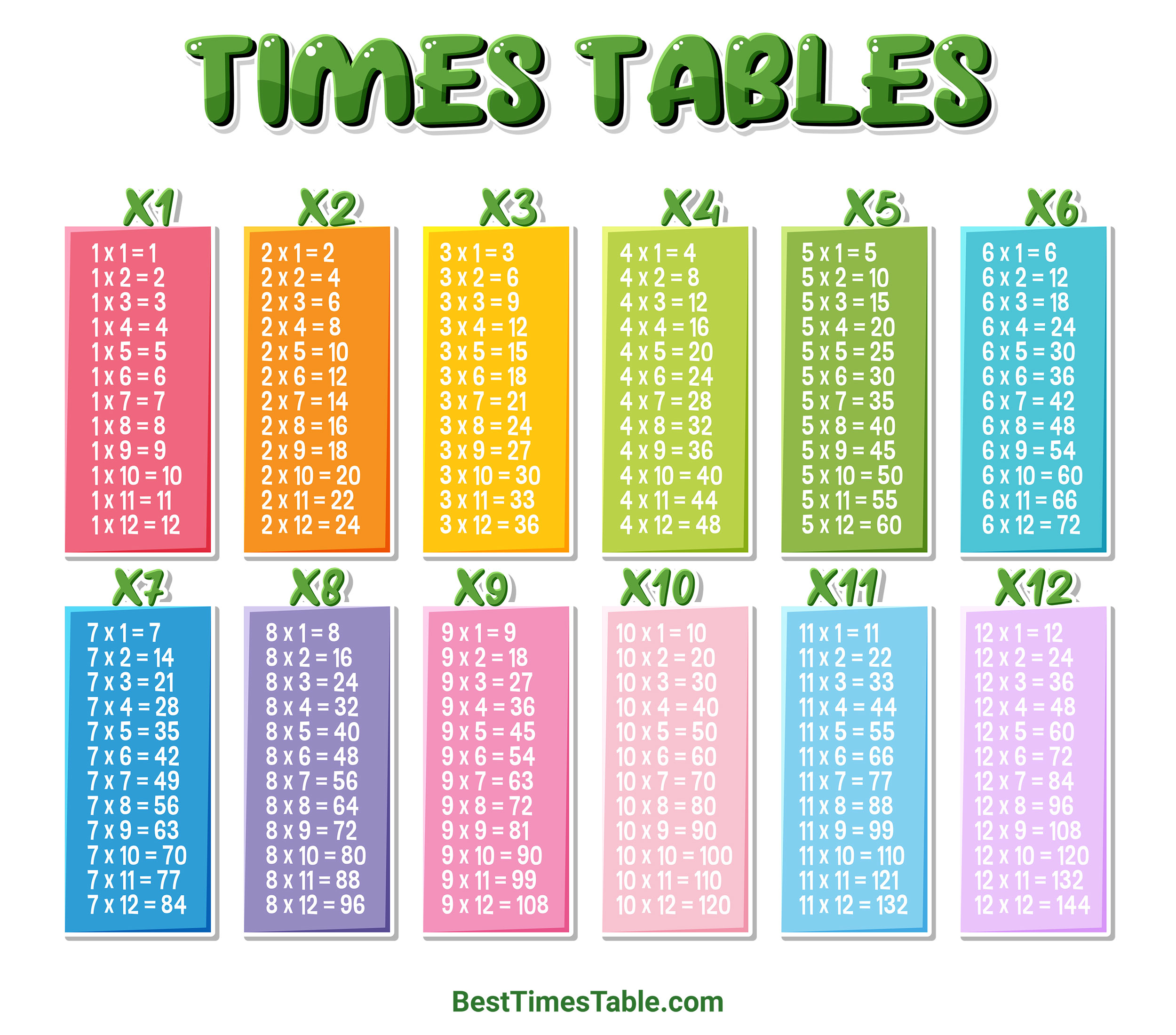
The 40 times table is closely connected to the 4 times table. Since 40 is 4 × 10, you can multiply by 4 first and then multiply the result by 10.
Use the interactive lesson below to learn the table of 40 from 40 × 1 to 40 × 12, explore useful number patterns, practice the multiplication facts, and learn mental-math strategies for multiplying larger numbers by 40.
The shortcut
Multiply the number by 4, then multiply the result by 10.
For example: 40 × 7 → 4 × 7 = 28 → 28 × 10 = 280
Learn • Practice • Master
40 Times Table
Learn the 40 times table from 1 to 12, practice the facts you miss, then test your speed.
Multiplication chart
40 Times Table Chart
| Calculation | Answer |
|---|---|
| 40 × 1 | 40 |
| 40 × 2 | 80 |
| 40 × 3 | 120 |
| 40 × 4 | 160 |
| 40 × 5 | 200 |
| 40 × 6 | 240 |
| 40 × 7 | 280 |
| 40 × 8 | 320 |
| 40 × 9 | 360 |
| 40 × 10 | 400 |
| 40 × 11 | 440 |
| 40 × 12 | 480 |
Memory helper
See the pattern
Practice mode
Build accuracy
What is
Speed test
How many can you answer?
Answer as many 40 times table questions as you can before the timer ends.
Speed question
Mental math shortcut
Use the 4 Times Table to Multiply by 40
A simple way to calculate a 40 times table fact is to use a multiplication fact from the 4 times table and then multiply the answer by 10.
This works because 40 = 4 × 10.
40 × 3 = 120
40 × 6 = 240
40 × 9 = 360
To calculate 40 × 8:
First calculate 4 × 8 = 32.
Then multiply 32 by 10.
32 × 10 = 320.
Therefore, 40 × 8 = 320.
If you already know the 4 times table, this gives you a quick way to calculate every fact in the 40 times table.
Another strategy
Double Twice, Then Multiply by 10
If multiplying by 4 does not come immediately to mind, you can reach the same answer by doubling twice. Multiplying a number by 4 is the same as doubling it and then doubling the result again.
40 × 5 = 200
40 × 7 = 280
40 × 11 = 440
To find 40 × 6:
Double 6 → 12
Double 12 → 24
Multiply 24 by 10 → 240
Therefore, 40 × 6 = 240.
This method can be especially helpful for mental calculations because doubling is often easier than recalling a multiplication fact directly.
Number sequence
Count Forward in Steps of 40
Every answer in the 40 times table is exactly 40 greater than the previous answer. The first twelve positive multiples of 40 are:
80
120
160
200
240
280
320
360
400
440
480
You can use this sequence to move from a multiplication fact you know to one nearby.
If you know 40 × 7 = 280, add another 40:
280 + 40 = 320
so 40 × 8 = 320.
You can also move backwards. Since 40 × 10 = 400, subtracting 40 gives 40 × 9 = 360.
Spot the pattern
What Pattern Does the 40 Times Table Follow?
Every whole-number multiple of 40 ends in 0. The final two digits follow a repeating pattern as you move through consecutive multiples:
40 → 80 → 20 → 60 → 00 → 40 → 80 → 20 → 60 → 00
For example, the sequence begins 40, 80, 120, 160, 200 and then continues 240, 280, 320, 360 and 400.
= 120
= 200
= 400
Every multiple of 40 is also divisible by 2, 4, 5, 8, 10, 20 and 40.
Useful connection
Double a 20 Times Table Answer
The 20 times table gives you another shortcut. Since 40 is twice 20, simply double a corresponding 20 times table answer.
40 × 4 = 160
40 × 7 = 280
40 × 12 = 480
This relationship works in reverse too. If you know a 40 times table answer, halving it gives the corresponding 20 times table answer.
40 × 9 = 360
Half of 360 = 180
Therefore, 20 × 9 = 180.
Beyond the basic table
How to Multiply Larger Numbers by 40
The ×4 then ×10 strategy works with numbers beyond 12, so it can be used as a general mental-math method rather than only as a way to memorize the table.
40 × 15 = 600
40 × 25 = 1,000
40 × 30 = 1,200
To calculate 40 × 24:
4 × 24 = 96
96 × 10 = 960
Therefore, 40 × 24 = 960.
You could also double 24 twice: 24 → 48 → 96, then multiply by 10 to reach 960.
A useful benchmark
Why 40 × 25 = 1,000 Is Worth Remembering
Some multiplication facts are useful beyond the table itself. One particularly convenient relationship is 40 × 25 = 1,000.
You can see why using the ×4 then ×10 strategy:
25 × 4 = 100
100 × 10 = 1,000
Therefore, 40 × 25 = 1,000.
This fact makes related calculations easier. For example, 40 × 50 is twice 1,000, giving 2,000, while 40 × 100 = 4,000.
Recognizing benchmark products like these can make mental multiplication with larger numbers much faster.
Check your recall
40 Times Table Practice Questions
Try each question before opening the answer. Use the 4 times table, repeated doubling, or a nearby multiple of 40 if you need help.
What is 40 × 4?
Use doubling to find 40 × 6.
If 20 × 7 = 140, what is 40 × 7?
If 40 × 8 = 320, what is 40 × 9?
What is 40 × 11?
What is 40 × 12?
Challenge yourself
Can You Multiply These Numbers by 40?
These questions go beyond 40 × 12. Try solving them mentally using ×4 then ×10 or repeated doubling.
What is 40 × 15?
What is 40 × 25?
What is 40 × 50?
What is 40 × 100?
Quick answers
40 Times Table Questions
What is 40 × 5?
40 × 5 = 200.
What is 40 × 6?
40 × 6 = 240.
What is 40 × 7?
40 × 7 = 280.
What is 40 × 8?
40 × 8 = 320.
What is 40 × 9?
40 × 9 = 360.
What is 40 × 10?
40 × 10 = 400.
What is 40 × 11?
40 × 11 = 440.
What is 40 × 12?
40 × 12 = 480.
What is the easiest way to multiply by 40?
Multiply the number by 4 and then multiply the result by 10. For example, 40 × 7 can be calculated as 4 × 7 = 28, followed by 28 × 10 = 280.
What are the first 12 multiples of 40?
The first 12 positive multiples of 40 are 40, 80, 120, 160, 200, 240, 280, 320, 360, 400, 440 and 480.