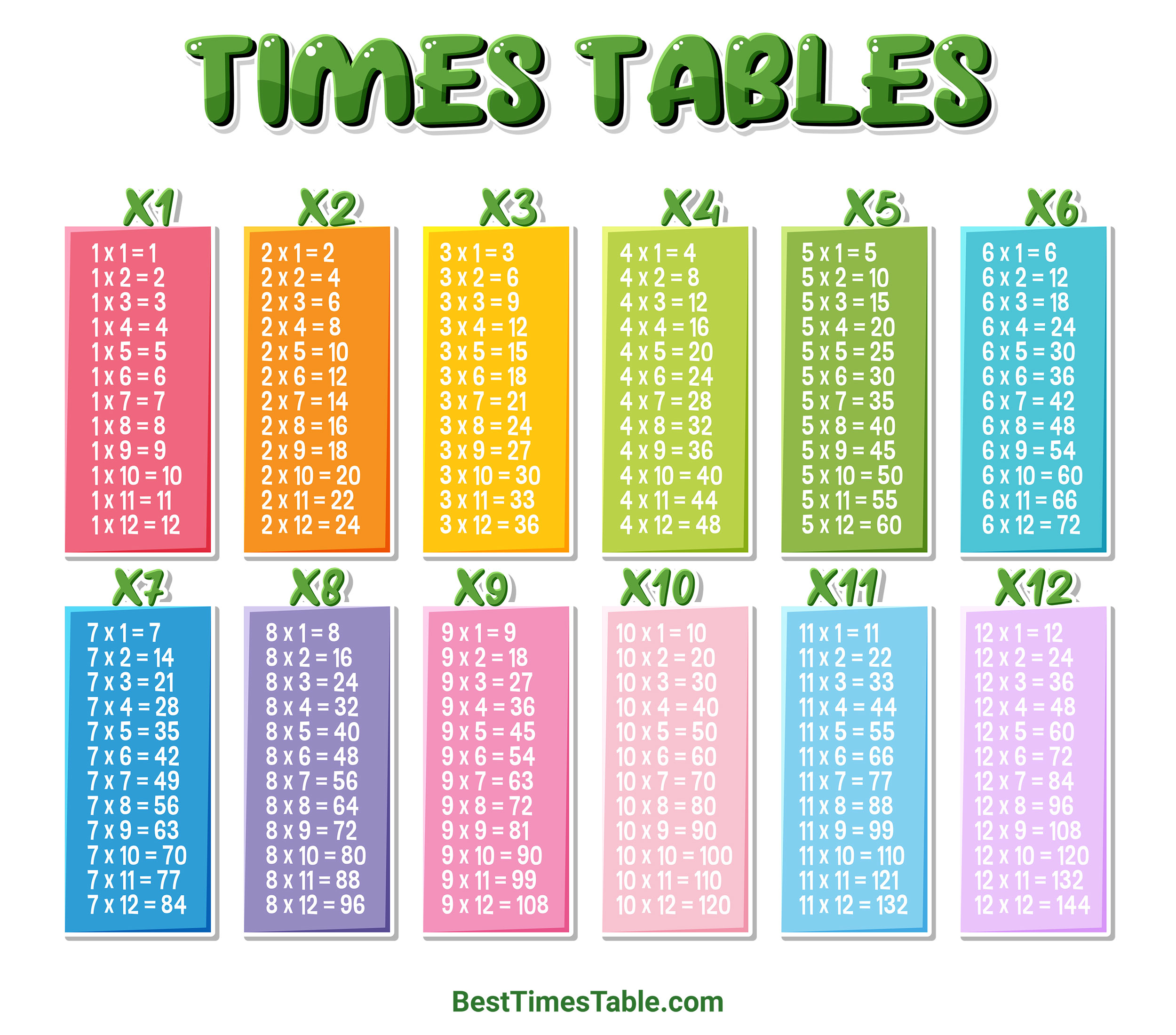
Learn your times tables from 1 to 12 with interactive multiplication tables, practice questions, speed tests and printable charts. Choose a table below, track your progress, or start with a quick mixed multiplication quiz.
Each lesson is designed to help you understand multiplication patterns first, then build faster recall through practice.
Start learning
Choose a times table and practice until the answers become automatic.
Start with easier tables such as 2, 5 and 10, then move on to the more challenging facts.
Choose a table
Times Tables 1 to 12
Select a multiplication table to open its complete lesson, interactive practice mode and timed test.
Your learning
Track Your Times Table Progress
Your progress is saved in your browser as you practice. Improve your accuracy and speed to increase your mastery score for each multiplication table.
Quick practice
Practice Mixed Times Tables
Instead of practicing one table at a time, try a mixture of multiplication facts from 1 to 12. This helps you recall answers without relying on the order of a multiplication table.
Mixed tables
Quick Times Tables Practice
Learn efficiently
How to Learn Times Tables
Learning multiplication is easier when you connect new facts to patterns you already understand. You do not need to memorize every multiplication fact in isolation.
Double
0 or 5
Place value
Example: if you know that 4 × 7 = 28, you can double 28 to find 8 × 7 = 56.
As you move through the tables, use doubling, skip counting, nearby multiplication facts and number patterns to work out unfamiliar answers. Then repeat those facts until you can recall them without using the shortcut.
Recommended order
Which Times Tables Should You Learn First?
There is no single required order, but some tables have simpler patterns and can provide useful building blocks for later multiplication facts.
Start with the 1, 2, 5 and 10 times tables
Move on to 3 and 4
Then practice 6, 8 and 9
Spend extra time on the 7 times table
Finish with 11 and 12
Visual learning
Explore the Multiplication Chart
A multiplication chart shows multiplication facts in a grid. Choose one factor across the top and another down the side, then find the product where the row and column meet.
= 42
= 64
= 108
Our interactive chart lets you highlight rows and columns, hide answers for practice, and switch between 12×12, 20×20 and 30×30 charts.
Beyond 1 to 12
Extended Times Tables
Once you are comfortable with the standard multiplication tables, explore larger multiples using the same mental-math strategies.
= 140
= 240
= 300
These larger tables are useful for mental maths because they can be built from easier facts. For example, 30 × 8 can be calculated as 3 × 8 = 24 and then 24 × 10 = 240.
Learn away from the screen
Printable Times Tables and Charts
Printable multiplication resources can be useful for homework, classroom practice or keeping a reference nearby while learning.
Printable
Color Multiplication Chart
A visual multiplication grid that can be printed and used as a quick reference.
Printer friendly
Black & White Chart
A simple multiplication grid that uses less ink when printed.
Reference sheet
Printable Times Tables
View the multiplication tables together in a traditional list format.
Build stronger recall
Practice, Check Mistakes and Test Your Speed
Knowing how to calculate an answer is the first step. The next goal is to recall common multiplication facts quickly and accurately.
Understand patterns
Fix mistakes
Build speed
Each individual times table lesson includes all three stages. Start by studying the table, move to multiple-choice or typed-answer practice, then try the timed speed test.
If you answer a multiplication fact incorrectly, the Practice mistakes mode lets you return specifically to facts that need more work.
Quick answers
Times Tables Questions
What are times tables?
Times tables are lists of multiplication facts for a particular number. For example, the 4 times table includes 4 × 1 = 4, 4 × 2 = 8, 4 × 3 = 12 and so on.
Which times tables should I learn?
The standard multiplication tables usually run from 1 through 12. Learning these gives you a strong foundation for mental arithmetic, division, fractions and later maths.
What is the easiest times table to learn?
The 1, 2, 5 and 10 times tables are often good starting points because they contain simple and predictable patterns.
What is usually the hardest times table?
Many learners find facts in the 7 and 8 times tables more difficult because they contain fewer obvious digit patterns. Breaking the calculations into multiplication facts you already know can make them easier.
What is 12 × 12?
12 × 12 = 144. This is the largest multiplication fact in the standard 1-to-12 multiplication table.
How can I memorize times tables faster?
Learn the patterns behind each table, practice short sets of questions regularly, spend more time on facts you miss, and gradually move from calculating answers to recalling them directly.
What is the difference between a times table and a multiplication chart?
A times table focuses on multiples of one number, such as the 7 times table. A multiplication chart combines many tables into one grid so you can find the product of two factors at their intersection.
Can I print the times tables?
Yes. Individual table pages include a Print table button, and printable multiplication charts are also available for offline practice.